History

History

Cultural Asset "Hyakudan Kaidan -The Hundred Stairs-" History


The Hyakudan Kaidan, designated as a Tokyo Metropolitan Area Designated Tangible Cultural Property, is a wooden building constructed in 1935.

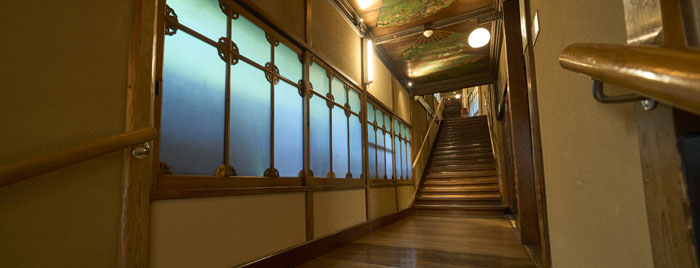
Once used as banquet halls for a traditional Japanese restaurant, the seven rooms where festive banquets were held are connected by a long staircase corridor consisting of 99 steps.

Each room connected by the staircase has its own unique ambiance, and the structure's defining feature is the extraordinary opulence of its decorations.

Featuring 126 Japanese paintings by leading artists of the early Showa period (1926-1989), as well as mother-of-pearl inlay work, kumiko sliding screens crafted without nails or adhesive, more than 750 pieces of cloisonné work inlaid into the ceiling, and a floor post made of cypress approximately 200 years old, this building is truly a palace of art and was designated a Tangible Cultural Property of Tokyo in 2009.

Chamber of Jippo
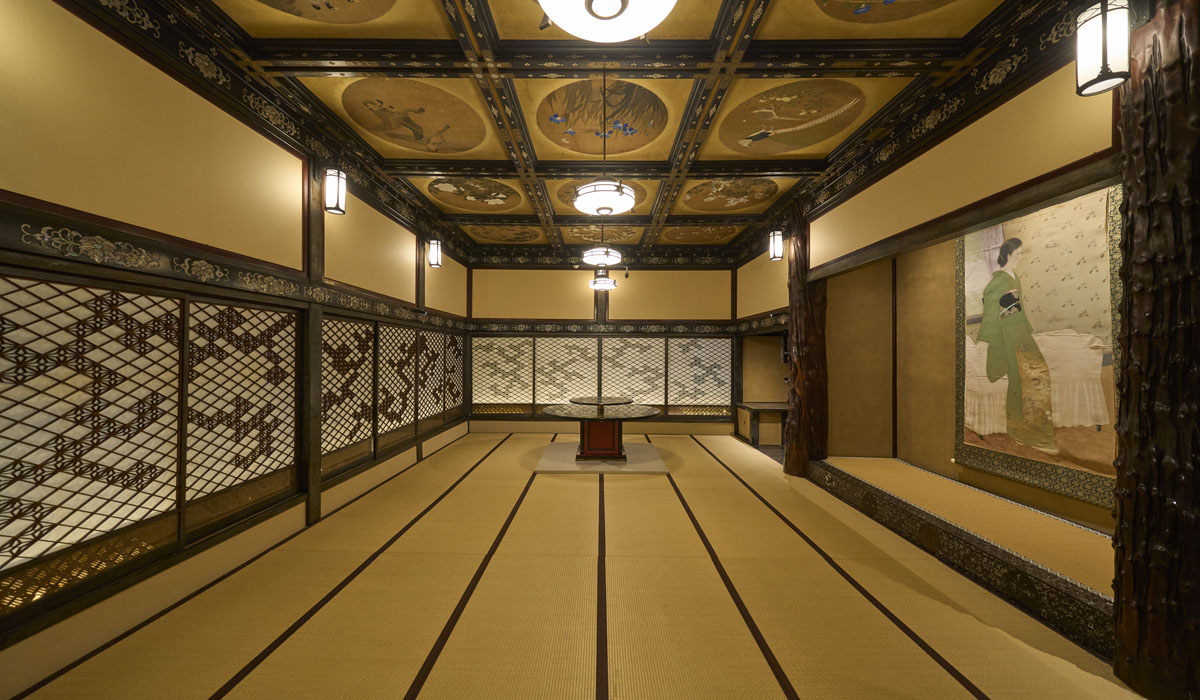

Chamber of Jippo, named after the artist responsible for the paintings within, Jippo Araki.Over 81 square meters in area, the ceilings are 4.8 metres high, making it the most spacious of the seven chambers. Please take a closer look at the ceiling. Jippo was particularly skilled in the use of sumi ink, and he harnessed that specialty to paint the 23 bird and flower works that decorate the ceiling.You will notice a difference in the colours used to paint the leaves. Compare the works on the ceiling of the front chamber near the entrance, which have leaves painted in rich hues, and those deep within the chamber, painted in sumi ink. The chamber itself was also decorated in a black theme to match Jippo s artistic style.
The lattice-like framework is known as a“ coffered ceiling”, and you will find the lattice portions have been minutely decorated in metal fittings with enamel flowers created using a technique called cloisonné. Cloisonné works ‒ or shippo-yaki in Japanese ‒ were usually made for export around the time the Gajoen was built, and while they were very valuable, they were not often seen on display in Japan. However, the ceiling of this chamber is decorated with more than 750 such items. One other feature of this chamber is the mother-of-pearl work seen in the ceiling beams and other structural elements. Mother-of-pearl is known as raden in Japanese, and it is made by slicing the lustrous inner surface away from oysters and other shellfish, cutting them into the desired pattern, and then embedding the pieces in place as decoration. Here the shells were painted in lacquer, then polished using charcoal.
You will find glittering scrollwork examples if you search the beams and around the tops of the walls slightly below the ceilings. Finally, let s take a look at the sliding doors ‒ or shoji ‒ mounted against the walls. The style of the frames is known as hishigumi kumiko, which refers to the geometrically-arranged hemp leaf pattern. The light coming through the shoji changes subtly when someone walks before them in bright light, casting a shadow, lending them a beauty that is truly indescribable.

Chamber of Gyosho
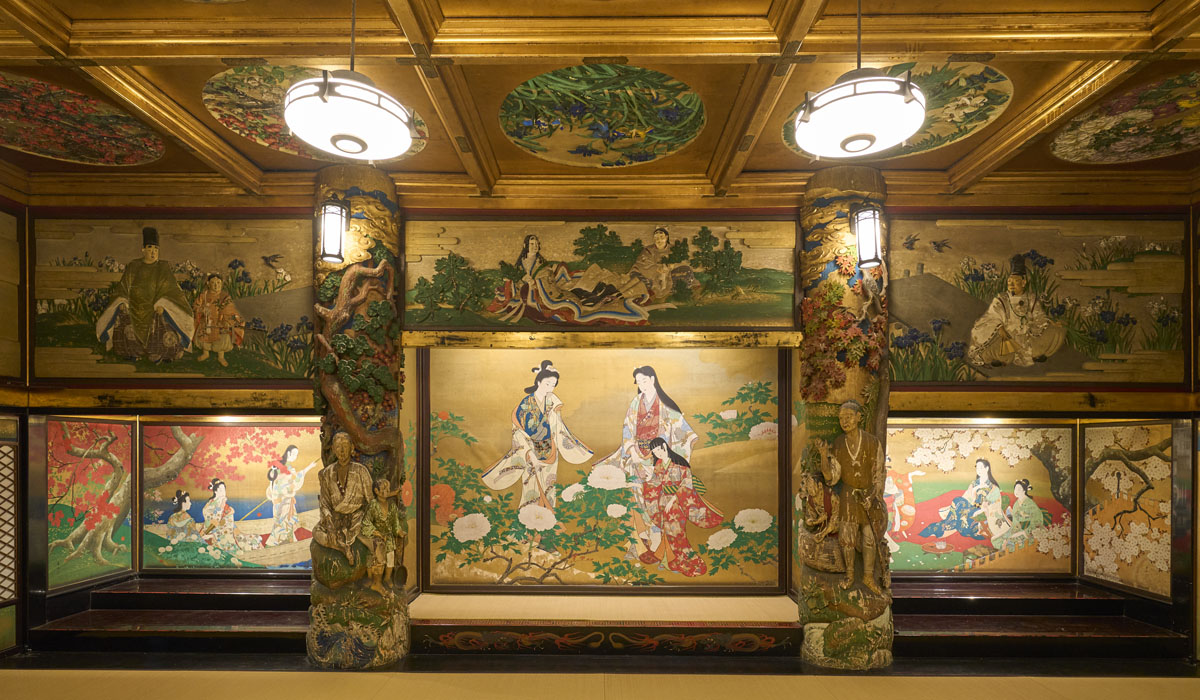

In the Chamber of Gyosho, you will find carvings throughout, on the pillars, walls and ceilings. Many of the chambers leading off the Hyakudan Kaidan are named after the artists engaged to create their décor, but this chamber is named after a famous Chinese theme called the“ Dialogue of the Fisherman and the Woodcutter”, and the carvings on the pillars here depict that tale. Let s continue on to the pillars. The left-hand pillar depicts the fisherman, while the right-hand pillar depicts the woodcutter. Every element of each sculpture contrasts an element in the other: river versus mountain, spring versus autumn, the sitting fisherman versus the standing woodcutter.
Originally, the fisherman and the woodcutter represented a longing for the spiritual richness found in living a slow, deliberate life surrounded by nature, and in Japan, the story is thought to have possibly been the origin of the legends about Yoro Falls and Urashima Taro. Both pillars were made from single pieces of Japanese cypress almost 300 years old. All of the sculptures in this chamber were carved by sculptor Horei Sakari and inspired by paintings by Chikuha Otake. The only ordinary paintings in the chamber can be found on the walls in the centre of the alcove and to the left and right of the pillars. These are bijin-ga works by a painter from Yamagata Prefecture named Kashu Kikuchi. Take a look at the panels in the upper portion of the walls. These panels are called ranma, and they depict the gosekku ‒ the five ceremonies held by the Heian period court. Let s talk a little bit about the gosekku as we look at the works. The first ceremony is depicted right above the alcove, and it took place on the seventh day of the new lunar year ‒ the years very first Day of the Rat ‒ a day called jinjitsu. Here we see participants holding small pine trees, complete with roots, as they pray for longevity while picking young green vegetables. A festival is depicted on the ranma on the wall on the right. This day was called joshi, and it fell on the third day of the third lunar month. Painted here is the peach festival held in celebration of Hina-matsuri or Girl s Day.
On either side of the alcove are scenes depicting the third ceremony ‒ tango ‒ celebrated on the fifth day of the fifth lunar month. The fourth ceremony is Tanabata and it occurs on the seventh day of the seventh lunar month, and it is depicted on the ranma on the wall opposite the alcove. During this festival, noble women would give offerings to the gods Orihime and Hikoboshi, burn incense, play music and enjoy poetry. They would make wishes by writing poems on the leaves of the paper mulberry tree, which had been considered holy since ancient times.Finally, on the ranma near the entrance to the chamber is depicted the ceremony on the ninth day of the ninth lunar month ‒ chōyō ‒ when people would enjoy sake served with chrysanthemum blossoms and pray for long lives.

Chamber of Soukyu
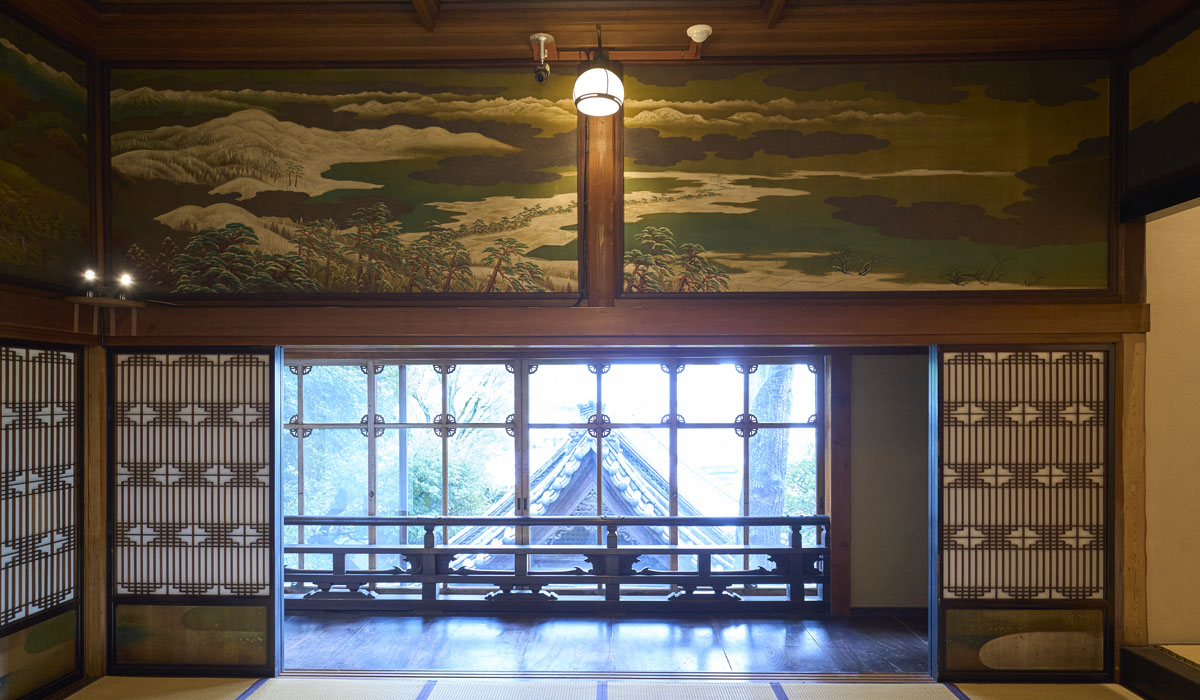

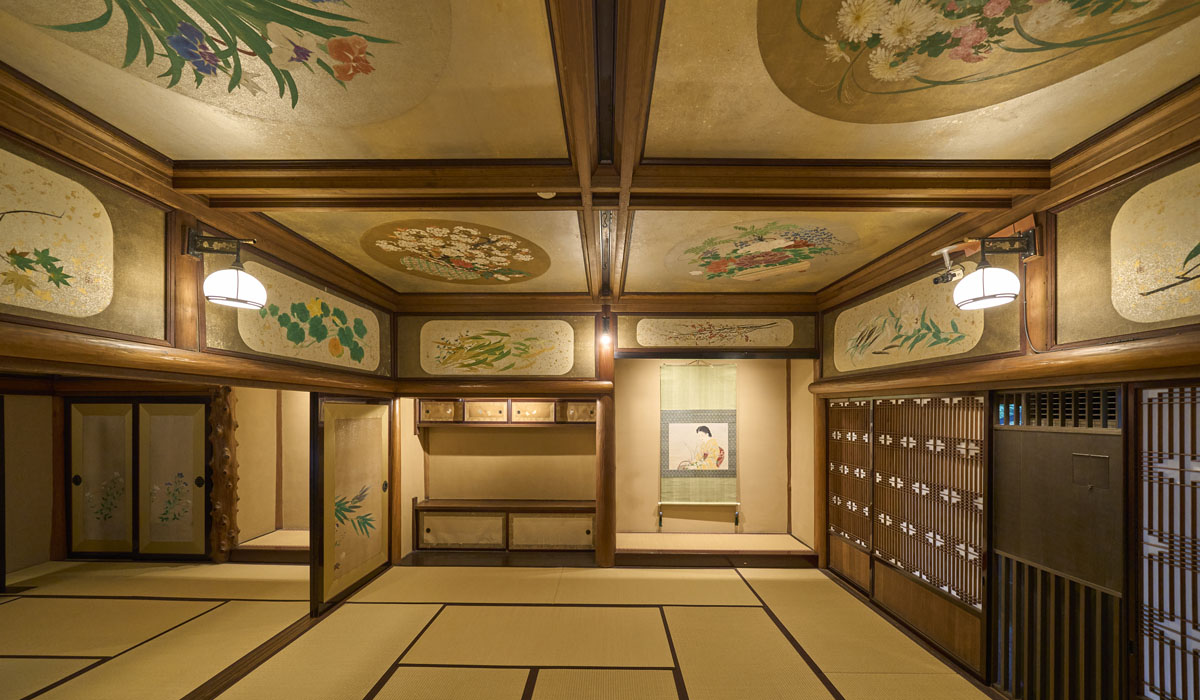
In the Chamber of Soukyu, Mt. Fuji is visible from this chamber when the weather is clear, and it was very popular for afternoon gatherings. Please continue into the chamber and take a look at the paintings on the ranma, which was the work of artist Soukyu Isobe. This chamber was originally separated into a front chamber and a main chamber, and the paintings on the ranma in the two chambers were different ‒ with closeup views in the paintings in the front chamber and distant views in the main chamber.
The wall of the former front chamber is painted with a thick pine tree at the heart of a waterfront scene. The powerful brush strokes used to express the branches of the pine are said to have been characteristic of works by Soukyu. The countryside and seaside landscapes in the main chamber create a panoramic feel.
We also see the passage of the year in the landscapes, from the rich green fields and paddies, to the rice harvest of autumn, and the snow-covered ground in winter. Please look up to the ceiling, where you will notice that the paintings in the front chamber and main chamber were made with differing themes. Both sides were built in the lattice-like coffered ceiling style, but in the front chamber we find flowers, while in the main chamber we find birds. The birds were painted with particular attention to detail, and even now their intense forms seem about to fly down out of the ceiling. Finally, let s take a look at the alcove. The pillarare made of wood from a Chinese pagoda tree. In ancient China, when a persons rank at court increased, they would plant a pagoda tree in their gardens, so it is said to have been a status symbol, with the larger the number of trees, the higher the person s rank.
The custom in Japan was to make demon masks out of pagoda tree wood to serve as amulets against evil, and in different regions of the country, the tree is said to have been a symbol of luck that would enable easy childbirth or long life.

Chamber of Seisui
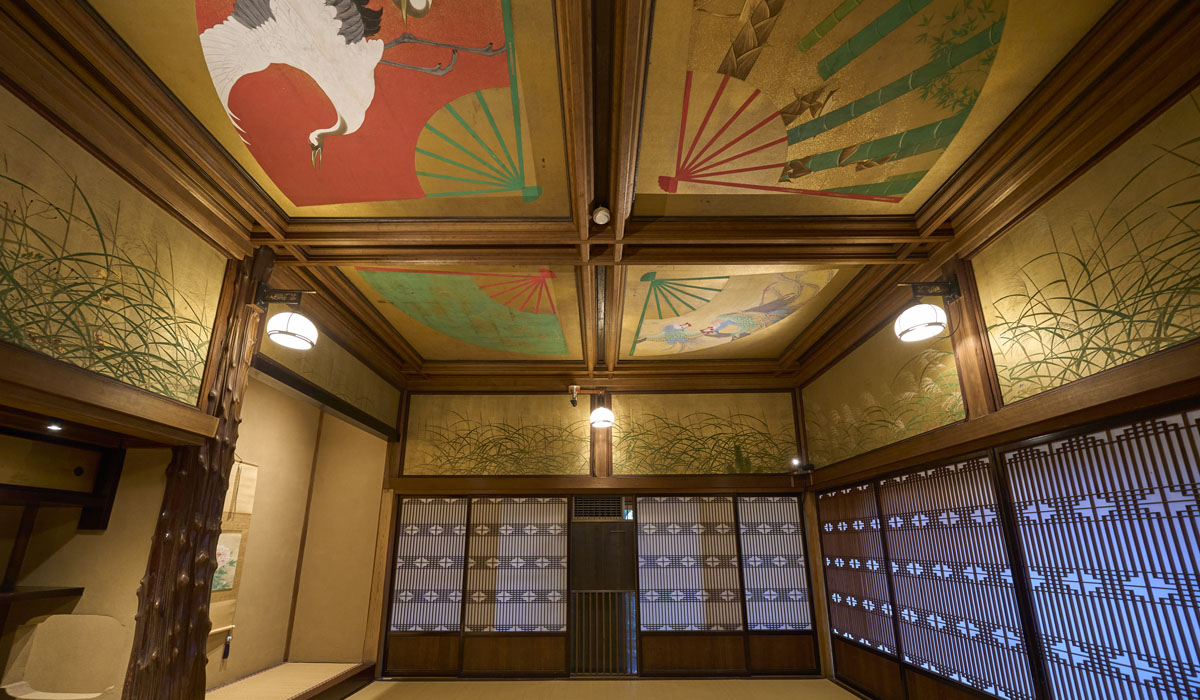

The previous chambers were all quite spacious at around 77 square metres in area, but from Chamber of Seisui and upwards, the chambers are split into two rooms, each around 20 square metres in size. This chamber is named after the Hiroshima-born painter Seisui Hashimoto, but in fact, the paintings within are the work of five different artists. Documents show that the work of Shūhō Yamakawa also graced the walls of this room, but at some point, the paintings were switched out, and it became Chamber of Seisui. On the ceiling of the antechamber just inside the rooms entrance are bird and flower paintings by Seisui, depicted within paper fan shapes in glorious colours.
On the ceiling of the far room, we find Chinese phoenixes, dancing cranes, and other auspicious imagery painted by artist Shūho Ikegami. The paintings on the ranma were by Taigetsu Koyama, who depicted autumn plants using gold leaf. Lets continue on to the alcove now, where we find the pillar is made of the unsquared trunk of an Amur cork tree. In the antechamber, the pillar is made of a type of pine on which the roots of each branch are still visible, giving the pillar even more depth. The connection between the complex shape of the pillar and the squared beam illustrates the great skill of the artisan who crafted it.

Chamber of Seikou


The décor within is the work of Kyōto painter Seikou Itakura, a specialist in a painting genre called bijin-ga, or “portraits of beautiful women.” The artist provided the room with a theme based on the seasons of the year. Auspicious fruits such as watermelon and persimmon are painted on the ranma in the antechamber, and we can also see crickets and mantises. The ranma in the following room depict seas onal foods such as ayu, flounder, and bamboo shoots. Let s also take a look at the ceiling in the second room. Titled“ Flower Baskets of the Four Seasons,” we see baskets full of the flowers of each season, with cherry blossoms for spring, irises and hydrangea for summer, chrysanthemums for autumn, and peonies for winter.
What makes these paintings very special is the fact that they were painted with highly durable mineral based pigments, so even now, years after they were painted, the colours are much more vivid than those seen in the other chambers.
Chamber of Seikou has the lowest ceiling of the cham bers on the Hyakudan Kaidan. The beams and pillars are all unsquared pieces of wood, and the ranma paintings are all short in height with rounded corners, which helps mitigate the oppressiveness of the shorter ceilings.
The familiar imagery and the careful attention of the artisans who built the room combine to create a space offering real comfort.

Chamber of Kiyokata
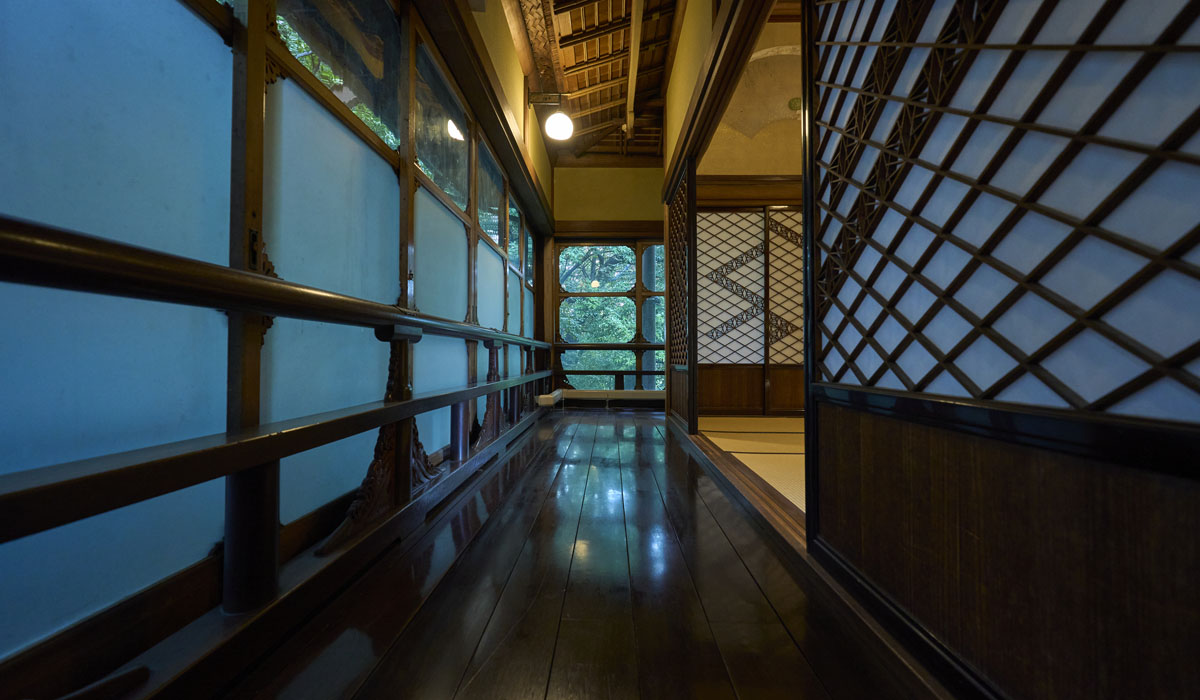

Chamber of Kiyokata
This room was the work of modern Nihon-ga master Kiyokata Kaburaki. Directly translated, the term Nihon-ga means“ Japanese-style paintings.”
Let s begin with the ranma paintings. In the main chamber are four works titled“, Beautiful women of the four seasons.” Above the alcove, we see a scene from a kabuki play called Musume Dojoji which takes place in spring under the cherry blossoms.To its left is a scene of figures catching fireflies, and the ranma even further to the left depicts the sorrow of autumn. The final image depicts a woman walking through the falling snow of winter.
These masterpieces all demonstrate Kiyokata's skill as a painter of bijin-ga.
Let s now take a closer look at the works in the antechamber.
Kiyokata loved the remnants of Edo-era elegance that could be ofund around Meguro, and apparently often incorporated them as themes in his work. Here we have some examples of such works connected to Meguro. First, there are two ranma paintings above the shelves. The one on the right depicts Gyōninzaka, the hill that still runs from Meguro Station to this Building, and the painting also includes images of bamboo shoots, a product Meguro was famous for. The painting on the left depicts Shirai Gonpachi, the main character of a kabuki play, dressed in a lavender-coloured kimono. The play tells the love story of a man named Gonpachi and a Yoshiwara courtesan named Komurasaki, a tale that enjoyed great popularity and was depicted in many works of art. Shirai Gonpachi was a real person, and a stone monument of his memory can be found at the temple Ryūsen-ji, a temple dedicated to the Buddhist deity Acala, known in Japanese as Fudō myō -ō. The purple irises that bloom at the feet of Gonpachi in this painting are said to symbolize his love for Komurasaki ‒ a name that means, “little purple”. Now, look towards the shelves, then turn to look at the ranma paintings on the wall to your left. Starting from the work on the left, we see a young Yūten ‒ the founder of the temple Yūten-ji ‒ in a scene that depicts the legend of Fudō Myō-ō appearing before Yūten in a dream. The central work depicts a kabuki actor named Ichikawa Danjūrō the ninth, who lived in Meguro, and to the rihgt is a painting of a stone bridge called Taikobashi that once crossed the Meguro River. Through Kiyokatas paintings, this space has become a place to experience the history and charm of the Meguro area.

Chamber of Chojo
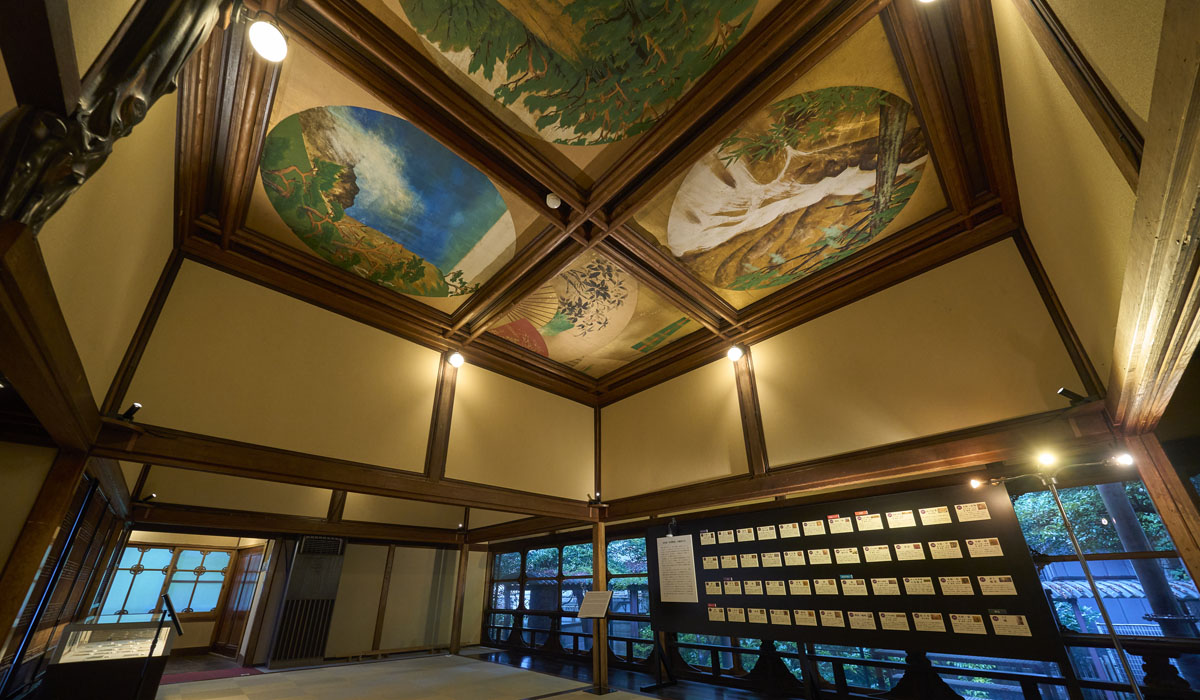

This chamber was originally planned to be decorated in the work of Gōun Nishimura, one of the masters of the Kyōto art world, but he sadly passed away before he could begin his work and the plan could not be brought to fruition.
It is perhaps for that reason that the pillar in the alcove is made from black persimmon wood, a material that is said to be extremely famous. In the end, the paintings on the ceiling were completed by a number of painters who studied under Eikyu Matsuoka.